
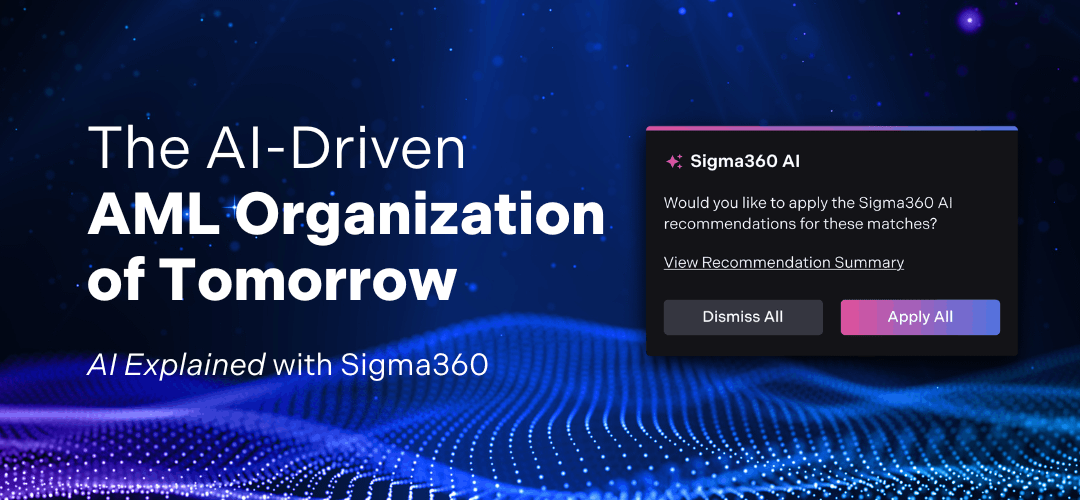
This is the fifth and final module in Sigma360’s AI Explained series – a beginner-friendly guide to understanding artificial intelligence in financial crime compliance. This series will break down the fundamentals of how AI works, why it matters in today’s compliance landscape, and how we can best implement AI within our risk screening workflows.
This module explores the AI-driven future of AML screening. We’ll dive into how AI reshapes investigative workflows and explore how governance frameworks keep automation accountable. Discover what the next generation of AML screening will look like.
| Key Term: AI GovernanceThe set of frameworks, committees, and ethical guidelines that ensure AI systems are transparent, explainable, and compliant with regulatory expectations. |
Today’s AML operations are under massive strain. Many financial institutions still depend on manual, fragmented workflows. Analysts spend hours on alert review, compiling data across multiple systems and writing exhaustive case narratives.
Even leading institutions view scaling as an inevitable trade-off. To expand screening capacity, companies often have to increase headcount and risk analyst fatigue. This equation no longer works in today’s environment.
Simply, AML operations are still trapped in reactive, high-cost processes that can’t scale. Fortunately, AI is the key to rebuilding smarter systems.
The “Before”: A Relentless Manual Grind
In traditional AML operations, compliance functions have to tackle overwhelming alert volumes and fragmented workflows. Every flagged transaction requires manual review. A simple data mismatch or common name could easily trigger this process. When these small triggers build up over time, they can drain resources and slow decision-making.
Compliance teams spend many hours of their time:
- Matching Decisions: Reviewing potential hits against sanctions, PEP, and adverse media lists.
- Escalating Alerts: Compiling and validating data from multiple systems to build complete case files.
- Closing Cases: Documenting every rationale to satisfy audit and regulatory expectations.
This outdated model is reactive, costly, and leads to widespread analyst fatigue. It relies on human effort to fix structural problems. This becomes harder as alert volumes increase and screening needs grow.
The “After”: AI as the Co-Pilot, Humans as the Strategists
AI redefines how AML functions and organizations operate. Instead of manually processing alerts, compliance professionals become strategic overseers of intelligent systems. Machine learning, generative AI, and agentic AI can now do most of an analyst’s more burdensome work. AI can automatically handle easily cleared alerts, consolidate risk insights, and surface high-risk cases.
This gives human analyst more time to focus on higher-level investigations and model governance. Compliance teams, and financial institutions as a whole, can save millions of unproductive work hours.
This is what the future state of AI AML operations looks like:
- Complex Case Resolution: Analysts focus on more nuanced or emerging financial crime cases. They can employ their talents where it counts.
- Model Governance and Tuning: Teams watch how AI performs and fix any bias or drift. They also improve models over time using feedback.
- Regulatory Interpretation: Human oversight and human-in-the-loop governance ensures AI decisions are transparent, explainable and auditable.
In this new paradigm, AI acts as a powerful tool. It allows people to focus on judgment, oversight, and strategy instead of manual review.
Building Trust Through Strong AI Governance
The impact of AI is only as strong as the governance behind it. Institutions must ensure they are deploying AI responsibly and that their AI aligns with evolving regulations.
Frameworks like Sigma360’s GRACE Evaluation Framework deliver a structured methodology for compliance leaders to assess Generative AI solutions. GRACE provides the blueprint to meet regulatory and internal audit expectations, enabling risk decisions that are fast, explainable, and inherently defensible.
Capco’s “Five Foundational Elements for GenAI Governance in Financial Services” echoes these principles. Organizations need to focus on cross-functional collaboration and ethical oversight to deploy AI responsibly.
Effective AI governance depends on two things:
- Diverse expertise: Compliance, data, cybersecurity, legal, and ethics teams should work together to set boundaries and review outcomes.
- Defined oversight: Appoint steering committees or AI Ethics Boards to approve AI-driven projects. They can set risk thresholds for AI models and ensure innovation aligns with control.
The Payoff: Scalable and Future-Ready AI AML Operations
When AI is deployed across the compliance ecosystem with strong model management and governance, we see the outcomes ripple across teams and functions.
- Scalability: Handle more alerts and higher volumes without adding analysts.
- Efficiency: Free teams from low-value reviews to focus on strategy and investigation.
- Regulatory confidence: Deliver explainable, well-documented decisions that stand up to regulatory scrutiny.
By deploying Agentic and Generative AI alongside robust governance frameworks like GRACE, institutions can make quicker risk decisions. This will help compliance teams feel more confident in every AI-driven outcome.
Ready to explore how agentic AI can transform your compliance operations? The future of financial crime prevention is autonomous, intelligent, and available today. Explore Sigma360’s extensive AI suite, AI360, here: https://www.sigma360.com/ai360.
Sigma360’s AI Explained series is your comprehensive guide to understanding AI’s role in financial crime compliance. Ready to stay ahead of the curve? Join our newsletter mailing list to receive the complete series and industry insights delivered directly to your inbox.